New stamps exhibit now on display in Library

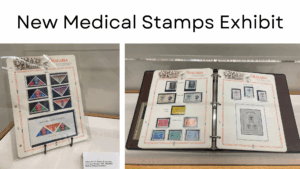
New Medical Stamps Exhibit with stamp scrapbooks featuring medical-related stamps

The newest exhibit from the UT Southwestern Special Collections Library & University Archives in the UT Southwestern Library features the personal stamp collection of Albert M. Tocker, M.D., who was an allergist in Dallas for several decades before his retirement in 1980.

The materials on display, which were donated shortly after his passing in 1983, cover medical and scientific milestones across the globe, including the W.H.O.’s fundraiser for the eradication of malaria; the 40th Anniversary of the Red Cross and Red Crescent federation; medical doctors and researchers of note; and localized commemorative stamps.

Many stamps in Dr. Tocker’s collection came from one source: a stamp dealer named Littlewoods, which produced bulletins reporting on the newest stamps released globally and held auctions tailored to collectors’ specific areas of interest.

EndNote 2025 has arrived!

EndNote 2025 is now available for download. Go to the EndNote Guide for links and instructions.

The 2025 edition features a new AI component called “Key Takeaways”, which extracts and summarizes important insights from articles and PDFs. Additional features include:

  • Find a Journal
  • Cite from a PDF
  • Summary Panel Redesign
  • Web of Science Citing Articles and Related Records
  • Find Reference Updates and Find Full Text Improvements
  • Sync Process Visibility
  • Option to Use En Dashes for Pages and Date Ranges
  • Library Details in Library Status Window
  • Updates to the Edit Tab

To find out more about the additional features, go to Clarivate’s EndNote 2025 Key Features post.

Pivot Funding Database Now Includes AI Features

Pivot, a funding opportunities database available through the Library, includes new AI-powered features: 

  • Semantic Search – AI-powered natural language searching available in the Advanced Search interface. The search is less precise, but it may uncover relevant opportunities not found using traditional search methods. 
  • AI-Generated Titles and Summaries – Found within a funding opportunity entry, these items improve discovery and review by providing additional context and description. The Advanced Search interface now defaults to also searching the AI-Generated summaries. 

For more information on the integration of AI into other Library tools, see the Artificial Intelligence Guide.

CINAHL and other EBSCO Interfaces Receive Upgrade

In August, all EBSCO databases including CINAHL‘s interface will be officially transferred to a more accessible platform. The librarians have trialed the interface and identified some significant changes which will be covered in our upcoming July 23rd class at 12 noon. This training is highly recommended for Nursing, APP, School of Health Professions, and School of Public Health affiliates.

On My Own Time registration ends July 9th

Registration for the 24th Annual On My Own Time Employee Art Exhibit is now open. Submissions may be submitted through July 9, 2025. If you are interested, the following links provide more information about the rules for submissions.

Please note that due to space constraints, only UT Southwestern employees and students may submit entries. Also, submissions are limited to the following:

  • Visual art: one (1) work of art per category
  • Literary works: three (3) entries per category

For more information including key dates and entry rules, please visit the UT Southwestern OMOT website.

Spot Predatory Journals Quickly – Cabells Data Now Powering LibKey! 

Say goodbye to deceptive journals!  LibKey now integrates Cabells data to seamlessly flag predatory journals—whether you’re searching on-campus or remotely. No matter where you browse—publisher sites like Elsevier and Wiley, databases like PubMed, or even Google Scholar—LibKey warns you if a journal is potentially predatory. Click the alert to uncover key violations and access the full report via Cabells Predatory Reports. Just install the LibKey Nomad browser to integrate with Cabells Predatory Reports.  Stay informed, stay protected! 

New Summer Interns to assist with Archives projects

The Special Collections Library and University Archives is happy to announce that we will be hosting two interns this summer from the university’s internship program. Each intern will provide valuable assistance in moving forward the mission of the University Archives. The first intern is Aigerim Atausha, a senior from Texas A&M University. She’ll be assisting with our book project. This on-going project is weeding the books in our History of Medicine Collection, determining if any of the books in the collection are rare, as well as evaluating the value of the books in the Rare Book Room. All of her work will be done under the guidance of our University Archivist, Kendall Martin.

Our second intern is Tamara Solayappan, a junior at the University of Texas at Austin. She’ll be assisting with a new digitization project focused on the Theses and Dissertations collection. Though this collection has digitized pieces, she’ll take on the role of primary digitizer and will create the metadata for each item as well as edit any scans as necessary. All of her work will be done under the guidance of the Digital Archivist/Manager, Angie Houser.

New Predatory Publishing Guide

Did you know that predatory publishers and organizers of predatory conferences prioritize profit over scholarly integrity? 

The recently launched Predatory Publishing Guide addresses the “what,” “why” and “how” of predatory publishers and predatory conference organizers. Risks include: 

  • Lack of peer review 
  • Limited visibility 
  • Impact 
  • Reputation damage to the author, conference participant, and institution 
  • Ethical concerns 
  • Copyright 

Efforts to fight predatory publishing require collaboration and support. Start with the Publishing Red Flags Handout Red Flags Handout. Additional tools and resources to identify predatory publishers and predatory conference organizers include: 

  • Cabell’s Predatory Journals 
  • Predatory Journal Checklist – created to assist researchers/scholars make an informed decision about where to publish. 
  • Think.Check.Submit – an international initiative to educate researchers/scholars in choosing a reputable Open Access journal.  
  • Conference Checker – the short questionnaire is designed to help to determine whether or not a conference is legitimate.  
  • Think, Check, Attend – an initiative to guide and assist researchers/scholars in choosing trusted conferences to attend and to present their research.  
  • Pivot – use as a starting point to review information and deadlines for open calls for papers from forthcoming conferences.  

Questions? Feedback? Use the Ask Us form or call 214-648-2001 Monday – Friday, 8:00 am – 5:00 pm. 

Updated changes to ProQuest Ebook Central

Over the last month, ProQuest has shared news about enhancements and changes that either have already been applied or will be coming soon to their ebook platform, ProQuest Ebook Central.

Ebook Central Research Assistant

This tool launched in beta on the platform on April 3rd and offers readers the opportunity to:

  • Assess content relevance faster with chapter-level takeaways
  • Deepen understanding with key concept highlights 
  • Discover related resources within your Ebook Central collection

This tool is seamlessly integrated into Ebook Central for owned and subscribed titles.

Ebook Central EPUB (Electronic Publication)

Starting May 1, 2025, Electronic Publications (EPUBs) will become the default display format in Ebook Central’s online reader instead of PDF. This change is being made to create a more accessible, user-friendly experience on the platform – especially for readers using assistive technologies.

EPUB is a responsive, flexible format that adapts to different screen sizes, supports interactive features, and works more effectively with screen readers. It also aligns with evolving accessibility standards and legislation.

Users will continue to enjoy a seamless reading experience, now with added flexibility to switch between EPUB and PDF with our online reader. However, please note that anyone who has referenced specific page numbers in materials may see some differences, as EPUB’s reflowable (responsive) format adapts to screen size.