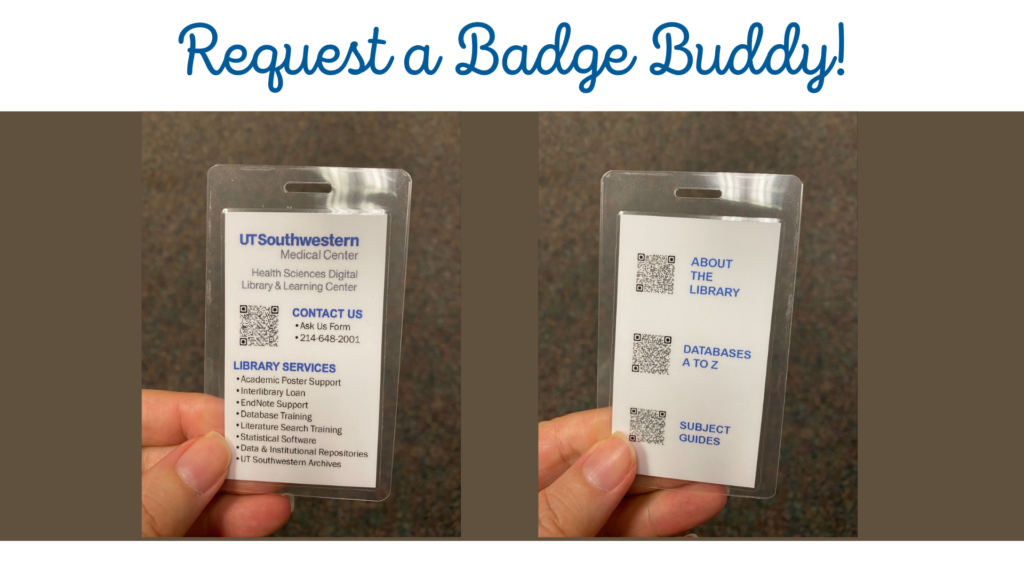
The Library has created handy badge buddies with helpful QR codes to connect you quickly to your Library resources. We can send it to your campus mailbox. Email LibAsk@utsouthwestern.edu to request yours today.

The Library has created handy badge buddies with helpful QR codes to connect you quickly to your Library resources. We can send it to your campus mailbox. Email LibAsk@utsouthwestern.edu to request yours today.

Every day, nurses make a real difference. Whether at the patient’s bedside, surgical suite, or clinic, your skill, compassion, and dedication to high-quality care help create a safer and more healing environment.
The Library staff celebrate you this week and every day—thank you for all that you do! Take a moment to explore popular Library nursing-focused resources designed to support patient care, research, evidence-based practice, quality improvement, and professional growth.
Stop by the Library’s table at the 2026 UTSW Education & Resource Day, pick up a badge buddy, fun stickers, and register for Library SWAG!
Beyond providing access to 400+ databases, 29,000+ e‑journals, and 700,000+ e‑books, we’re here to support your work in countless ways.
Reach out to us anytime if you need…
The Library is here to make your work easier—just ask! Use the Ask Us form or call 214-648-2001 Monday – Friday, 9:00 am – 4:00 pm.
Publication data from calendar year 2025 has been gathered from the Library’s open access publishing agreements, and UT Southwestern authors saved more than $1 million in article processing charges (APCs) during the year.
The Library’s agreements allow UTSW corresponding authors to publish articles as open access either at no charge through an APC waiver or with a 10-15% APC discount. In 2025, the total value of APC waivers or discounts from the top 10 publishers equaled $1,026,561. The 2024 total of APC waivers and discounts was $738,788.50, so the 2025 total represents an overall 39% increase.
The Library has recently added three new 2026 agreements: JAMA Network, Royal Society of Chemistry, and Springer Nature. (Please note: the JAMA agreement excludes JAMA, and the Springer agreement includes neither the Nature journal portfolio nor Springer’s fully open access journals.) Please refer to the Library’s APC Guide for more information about our current agreements.
EndNote 2025 is now available for download. Go to the EndNote Guide for links and instructions.
The 2025 edition features a new AI component called “Key Takeaways”, which extracts and summarizes important insights from articles and PDFs. Additional features include:
To find out more about the additional features, go to Clarivate’s EndNote 2025 Key Features post.
Because many people have used Zotero while at their previous institutions, the Library is providing a new class that compares EndNote with Zotero. This class is intended to help those who are familiar with Zotero but would like to learn about the differences and similarities between the platforms.
The class will be held virtually on Tuesday, April 15, at 12 p.m., and registration is required. (Note: If you are interested in this training but can’t attend, please register anyway, and we will send you a link to the recording.)
Are you considering undertaking a systematic review or another type of evidence synthesis, but you do not know where to start? Are you currently working on a review and need a refresher? If so, your Library is here to help.
The Library’s instruction team has adapted the single “Introduction to Systematic Reviews” session into a more digestible series this spring. This 3-part series will guide you through the entire evidence synthesis process: from PICO question formulation and protocol development to systematic searching techniques to data extraction and synthesis. We will highlight databases and tools to assist you and streamline your project.
If you are interested, click on the links below to register for individual sessions. If you cannot attend the sessions, you can still register so that you will receive the recordings.
Evidence Synthesis Essentials, Part 1: From PICO to Protocol
Tuesday, March 25, 2025
1 – 2 p.m.
Evidence Synthesis Essentials, Part 2: Systematic Searching Techniques
Tuesday, April 8, 2025
1 – 2 p.m.
Evidence Synthesis Essentials, Part 3: Screening, Extracting, and Synthesis
Tuesday, April 22, 2025
1 – 2 p.m.
Don’t forget your favorite stocking stuffers from the Library:
· Access the New York Times, Wall Street Journal, Harvard Business Review or Fortune for free with our institutional subscriptions.
· BrowZine is an app for Apple or Android smart phones and devices that helps you flip through the scholarly electronic journals available through UT Southwestern Medical Center.
· LibKey Nomad brings the Library’s journal holdings to wherever you are searching, both on- and off-campus.
· Read & Publish Agreements demonstrate how the Library supports open access publishing. Participating publishers include Cambridge University Press, Elsevier, Sage Premier, Wiley, and many more.
· Upgrade to EndNote 21 to help manage bibliographic citations.
· Brush up on your research skills and sign up for a class.
Out of the 423 entries received, we had one perfect score! Congratulations Ishrat Durdana! We had a tie for runner-up, Teri Lipscomb and Austin Matheis both only missed one. Thanks to all who participated!
Over the years, the breadth of methodologies and types of complex searches the Library supports has evolved, and the Library has produced the new Systematic Review and Evidence Synthesis Guide, which includes new content of other types of evidence synthesis. In this revised guide, the terms “evidence synthesis” and “knowledge synthesis” are used interchangeably and encompass a broad group of review families, including – but not limited to – systematic review, meta-analysis, integrative review, rapid review, scoping review, and umbrella review.
Not sure where to start?
The guide provides an overview of the UT Southwestern Library Systematic Review Process, guidelines/best practices, practical tips, and a glossary. With over 40 different systematic review/evidence synthesis types (Sutton, Clowes, Preston, & Booth, 2019), the researcher needs to decide which evidence synthesis/systematic review to perform. Criteria to consider include scope, comprehensiveness, time constraints, resources and types of studies that should be included. Right Review is one of the more popular available tools to help determine which type of review is appropriate for the research project.
To learn more about systematic reviews and other evidence synthesis types, you can call 214-648-2001, Monday – Friday 9 a.m. – 4 p.m.; register for a class; sign up for an individual training session; or use the Ask Us form.