
LibKey Nomad now offers a new Problematic Publishers feature to help researchers make more informed decisions about the journals and publishers they encounter online. When users visit a publisher’s website or find an article associated with a publisher that has identified concerns, LibKey Nomad displays an alert and explains issues related to areas such as peer review, editorial oversight, publication fees, open-access rights, or publisher transparency. The alert does not prevent access to the content; instead, it provides helpful context so researchers can evaluate the publication carefully before reading, citing, or submitting their work. 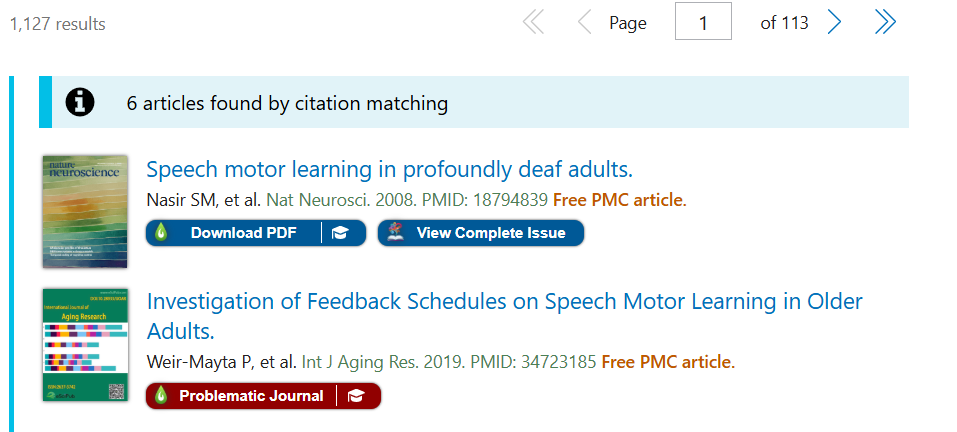
Category Archives: Electronic Journals
Update on Wiley APCs
The Library has provided a transformative publishing agreement with Wiley for several years that provides open access publishing at no charge to UT Southwestern, but this agreement allows for a maximum number of articles to be published each year. For 2026, this maximum is 149 articles.
As of August 1, we have less than 30 articles remaining, and once the maximum is reached, UT Southwestern authors will need to find alternative funding for the articles if they wish to publish them as open access in Wiley journals. We estimate this may happen in mid- to late-September.
Until that time, please be aware that articles aren’t officially counted towards the agreement until they are officially accepted. For articles submitted to a hybrid Wiley journal, acceptance happens when the article enters the publication queue and after peer review has occurred.
However, articles submitted to a Wiley or Hindawi fully open access journal follow a different path because they enter the publication queue when they are submitted and still need to go through the peer review process. They are only accepted after the review process is complete, which may take a long time.
Once the cap is reached, authors who already have articles in the publication queue will be notified that funding is no longer available, and they will have the option of either proceeding with open publishing if alternative funding can be found or choosing to publish their article behind the subscription paywall.
If you have any questions about this or would like to discuss things further, please contact LibraryOA@UTSouthwestern.edu.
Library APC agreements save campus more than $1 million
Publication data from calendar year 2025 has been gathered from the Library’s open access publishing agreements, and UT Southwestern authors saved more than $1 million in article processing charges (APCs) during the year.
The Library’s agreements allow UTSW corresponding authors to publish articles as open access either at no charge through an APC waiver or with a 10-15% APC discount. In 2025, the total value of APC waivers or discounts from the top 10 publishers equaled $1,026,561. The 2024 total of APC waivers and discounts was $738,788.50, so the 2025 total represents an overall 39% increase.
The Library has recently added three new 2026 agreements: JAMA Network, Royal Society of Chemistry, and Springer Nature. (Please note: the JAMA agreement excludes JAMA, and the Springer agreement includes neither the Nature journal portfolio nor Springer’s fully open access journals.) Please refer to the Library’s APC Guide for more information about our current agreements.
Library Transitions to Targeted Elsevier Journal Subscriptions – Effective January 2026
UT Southwestern Library will transition from a multidisciplinary ScienceDirect journal bundle to a targeted individual journal subscription model, effective January 2026.
Key factors driving this transition:
- Usage-driven selection to identify/prioritize journals with highest historical downloads
- Elimination of redundant titles already accessible through alternative platforms
- Strategic alignment with stable open access alternatives where available
All authorized members of the UT Southwestern community will retain access to articles via Interlibrary Loan (ILL), with no processing fees. In most cases, requests will be fulfilled within 24 hours through South Central Academic Medical Libraries (SCAMeL) partners and other lending libraries.
Consult the Library’s How to Request a Article from Interlibrary Loan tutorial for instructions on where to register for an ILL account and how to request and retrieve an article. The Library appreciates your understanding as they implement this strategic transition. For questions or concerns, use the Library’s Ask Us Form.
Library Stocking Stuffers You’ll Love!
Don’t miss out on these must-have goodies from the Library—perfect for your academic and research projects!
- Enjoy complimentary access to the New York Times, Wall Street Journal, Harvard Business Review or Fortune through our institutional subscriptions
- LibKey Nomad – take the Library’s journal holdings with you wherever you search on- or off-campus.
- Open Access Made easy – discover how our Read & Publish Agreements support your scholarly open access publishing with top publishers like Cambridge University Press, Elsevier, Sage Premier, and Wiley!
- AI Research Assistants and Prompt Engineering – explore our AI Guide, sign for a class or request personalized training!
- EndNote 25 is here – have you upgraded yet! Try “Key Takeaways,” EndNote 25’s new AI feature which extracts and summarizes key insights from your articles.
Spot Predatory Journals Quickly – Cabells Data Now Powering LibKey!
Say goodbye to deceptive journals! LibKey now integrates Cabells data to seamlessly flag predatory journals—whether you’re searching on-campus or remotely. No matter where you browse—publisher sites like Elsevier and Wiley, databases like PubMed, or even Google Scholar—LibKey warns you if a journal is potentially predatory. Click the alert to uncover key violations and access the full report via Cabells Predatory Reports. Just install the LibKey Nomad browser to integrate with Cabells Predatory Reports. Stay informed, stay protected!

New Predatory Publishing Guide
Did you know that predatory publishers and organizers of predatory conferences prioritize profit over scholarly integrity?
The recently launched Predatory Publishing Guide addresses the “what,” “why” and “how” of predatory publishers and predatory conference organizers. Risks include:
- Lack of peer review
- Limited visibility
- Impact
- Reputation damage to the author, conference participant, and institution
- Ethical concerns
- Copyright
Efforts to fight predatory publishing require collaboration and support. Start with the Publishing Red Flags Handout Red Flags Handout. Additional tools and resources to identify predatory publishers and predatory conference organizers include:
- Cabell’s Predatory Journals
- Predatory Journal Checklist – created to assist researchers/scholars make an informed decision about where to publish.
- Think.Check.Submit – an international initiative to educate researchers/scholars in choosing a reputable Open Access journal.
- Conference Checker – the short questionnaire is designed to help to determine whether or not a conference is legitimate.
- Think, Check, Attend – an initiative to guide and assist researchers/scholars in choosing trusted conferences to attend and to present their research.
- Pivot – use as a starting point to review information and deadlines for open calls for papers from forthcoming conferences.
Questions? Feedback? Use the Ask Us form or call 214-648-2001 Monday – Friday, 8:00 am – 5:00 pm.
Additional open access opportunities for UT Southwestern authors
Two publishers have adopted a Subscribe to Open (S2O) model for their primary research journals, starting in 2025. Through this model, when a library renews its journal subscriptions, an institution’s authors are able to publish in it without incurring article processing charges (APCs).
The specific publishers we are highlighting today are as follows:
- American Physiological Society: UT Southwestern corresponding authors may publish articles in one of the society’s 10 primary research journals with no APCs, and the published articles will be published as open access.
- American Society for Microbiology: The S2O model has been adopted for the society’s six primary research journals, and UT Southwestern authors will benefit from uncapped open access publishing without incurring APCs. Page charges and supplemental material fees will apply, but discounts are available for authors courtesy of the Library’s current subscription.
Please note: If enough libraries renew subscriptions under this model, the journals are converted to open in their entirety for all readers. If not, the access to the journals remains restricted to subscribing institutions.
For more information or to review other open access opportunities, please see the Library’s APC Guide.
New Year’s Resolutions Reminders
Happy New Year! As we look ahead to 2025, here are a few notes and reminders:
- UpToDate – To retain uninterrupted access to UpToDate Anywhere, you must re-verify your UTSW affiliation once every 90 days.
- Wiley APCs – UT Southwestern authors have fully utilized the 2024 maximum number of articles to be published at no charge in a Wiley or Hindawi fully open access journal or hybrid journal. But there is good news: the balance resets on January 1, 2025!
- Author Profiles – Are your researcher profiles current in ORCID, Scopus, and Web of Science? These profiles function as persistent identifiers for you and will follow you throughout your career, increase the visibility of your scholarly activities to grant funders and potential collaborators, and improve the accuracy of your author level metrics.
- Test Preparation – Did you know there are UT Southwestern test preparation resources available for residents/fellows, medical students, advanced practice providers and nurses?
Favorite Library “stocking stuffers”
Don’t forget your favorite stocking stuffers from the Library:
· Access the New York Times, Wall Street Journal, Harvard Business Review or Fortune for free with our institutional subscriptions.
· BrowZine is an app for Apple or Android smart phones and devices that helps you flip through the scholarly electronic journals available through UT Southwestern Medical Center.
· LibKey Nomad brings the Library’s journal holdings to wherever you are searching, both on- and off-campus.
· Read & Publish Agreements demonstrate how the Library supports open access publishing. Participating publishers include Cambridge University Press, Elsevier, Sage Premier, Wiley, and many more.
· Upgrade to EndNote 21 to help manage bibliographic citations.
· Brush up on your research skills and sign up for a class.